Key points
- The Riverina Murray is one of NSW’s most important agricultural regions, supporting a range of farming types and related industries such as manufacturing. The region contains diverse landscapes and ecosystems, including alpine areas in the Snowy Mountains to the meandering rivers and wetlands of the low-lying floodplains.
- Climate change is affecting the Riverina Murray. Projections show temperatures are expected to rise, rainfall patterns will change, and there will be increased risk of severe weather events such as bushfire, floods and drought.
- The NSW Government is helping the Riverina Murray adapt to climate change through the Enabling Regional Adaptation work. This is being achieved by working with state and local government stakeholders to identify key aspects of the Riverina Murray region that are vulnerable to climate impacts, along with challenges and opportunities to adapt.
Importance of the Riverina Murray region








The Riverina Murray region encompasses the traditional lands of the Barapa Barapa, Nari Nari, Ngarigu, Ngunawal, Wolgalu, Wemba Wemba, Wiradjuri, Yita Yita and Yorta Yorta peoples. It includes the major regional cities of Albury, Wagga Wagga and Griffith, which are home to more than 50% of the region’s population. Known as Australia’s food bowl, the region supports diverse industries including farming, viticulture and tourism.
Its population has a higher proportion of children compared to the NSW and ACT average.
The region contains over 7,701 cultural heritage sites and 13 officially protected Aboriginal Places. Many of these sites are considered to be highly significant and include sites used for burials, ceremony and dreaming, and places that have social and contemporary usage for Aboriginal people today.
The region features large floodplains and relatively flat river valleys, including some of the longest rivers in Australia such as the Murray, Murrumbidgee and Lachlan rivers. The floodplains and rivers have made the Riverina Murray one of Australia’s most important agricultural areas.
The region includes some of Australia’s rarest and most significant natural ecosystems, which range from the highest altitudes of the Australian continent to semi-arid ecosystems in south-west NSW and on the Hay Plains. In the west of the region, wetland communities associated with the major rivers rely on the snowmelt and rainfall from the highest peaks, including 2 internationally significant Ramsar sites (NSW Central Murray forests and Fivebough and Tuckerbil Swamps).
Known as Australia’s food bowl, the region supports diverse industries including farming, viticulture and tourism. The region is also one of Australia’s most significant locations for freight and logistics, with various transport hubs and corridors servicing the east coast. With access to the Port of Melbourne, the region’s producers have strong connections to export markets.
The largest industries of employment for the region are health care and social assistance, agribusiness, retail trade, education and training and manufacturing.
These cultural, environmental, and economic values are just some aspects of the region which have been identified as being highly vulnerable to climate change. Climate change is already affecting the Riverina Murray region, particularly through increased temperatures. The impacts of this can be seen through recent prolonged drought and the widespread bushfires of 2019–2020.
The region’s climate has provided the foundation for many of the region’s current social, ecological, and economic systems. Now, climate change is altering these foundations, with impacts already visible and expected to grow as they are impacted by increased temperatures, more hot days, fewer cold nights, higher rainfall variability, and greater fire danger.
How the Riverina Murray is affected by climate change
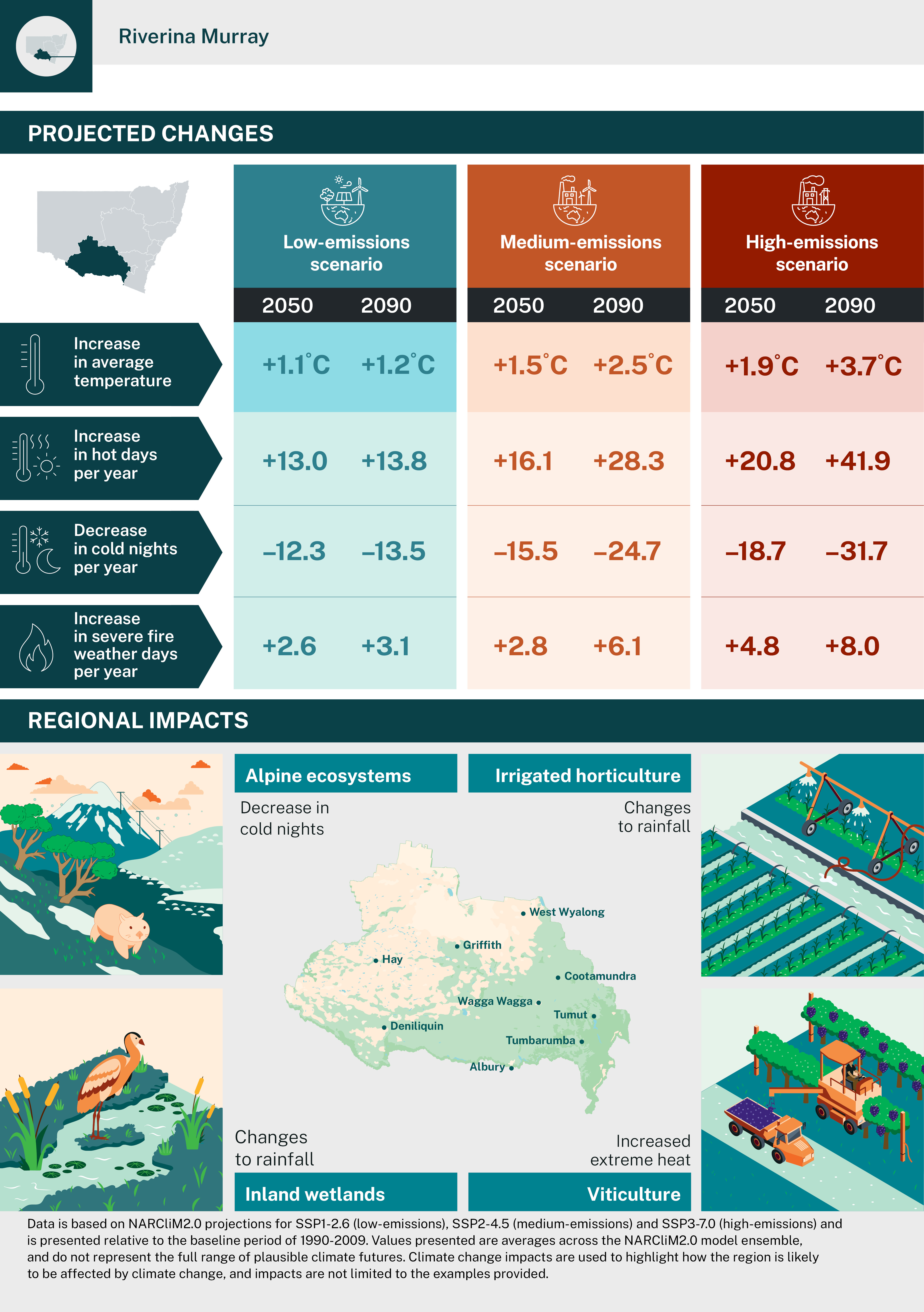
Climate projections for the Riverina Murray are shown relative to a baseline. This consistent reference point (the baseline) avoids the problems that could occur if future projections are measured against a shifting point of comparison, such as a constantly moving 'current' period.
- The baseline period: the modelled average of the 20-year period between 1990-2009.
- Middle of the century (2050): the projected average of the 20-year period between 2040-2059.
- End of the century (2090): the projected average of the 20-year period between 2080-2099.
Detailed information on the projected climate changes for the region can be found in the Riverina Murray snapshot or can be explored further through the interactive climate change projections map.
Projections for the Riverina Murray






Temperature
Across the Riverina Murray region, average temperatures are projected to rise throughout this century under all emissions scenarios. The main difference between scenarios is the scale of change: lower emissions show slower and more moderate increases, while higher emissions lead to a greater and ongoing rise in average temperature.
Under a low-emissions scenario, the rate of average temperature increase is expected to slow around the middle of the century. Under medium- and high-emissions scenarios, temperatures are expected to keep climbing past the middle of the century with no sign of levelling off by the end of the century, with faster and greater increases under a high-emissions scenario.
Hot days
Across the Riverina Murray region, the number of hot days is projected to increase throughout this century under all emissions scenarios. The main difference between scenarios is the scale of change: lower emissions show slower and more moderate increases, while higher emissions lead to a greater and ongoing rise in the number of hot days.
Under a low-emissions scenario, the rate of increase is expected to slow around the middle of the century. Under medium- and high-emissions scenarios, the number of hot days is expected to keep rising past the middle of the century, with no sign of levelling off by the end of the century, with faster and greater increases under a high-emissions scenario.
Cold nights
There will be noticeably fewer cold nights in the Riverina Murray region this century. The main difference between scenarios is the pace and size of the decline: lower emissions slow the change, while higher emissions lead to faster and greater losses.
Under a low-emissions scenario, the decline of cold nights slows around the middle of the century. Under a medium- and high-emissions scenarios, the number of cold nights continues to decline past the middle of the century, with no sign of levelling off, and by the end of the century the region could have very few, if any, cold nights under a high-emissions scenario.
Rainfall
Annual average rainfall in the Riverina Murray region is projected to remain variable throughout this century but is projected to decline under all emissions scenarios. The main differences between scenarios are in how large the reductions are and when they occur.
By the middle of the century, the high-emissions scenario shows a noticeably greater drop in annual rainfall than the low- and medium-emissions scenarios. By the end of the century, the differences between scenarios change their behaviour, rainfall continues to decline under the low- and medium-emissions scenarios, while the high-emissions scenario shows a slight increase in rainfall from the middle of the century but still remains below current levels.
| Case study Changes to rainfall and increased temperatures from climate change are expected to have significant impacts on the region. There is the potential for an increased risk of lower median inflows in key river catchments such as the Murray and Murrumbidgee rivers. For the NSW Central Murray Forests, the reduced frequency, extent and duration of spring floods from water extraction and climate change have already impacted the ecological character of the Ramsar site and caused a significant decrease in waterbird breeding. |
Severe fire weather
Across the Riverina Murray region, the number of severe fire weather days is projected to rise throughout this century under all emissions scenarios. The main difference between scenarios is the scale of change: lower emissions show slower and more moderate increases, while higher emissions lead to a greater and ongoing rise in number of severe fire weather days.
Under a low-emissions scenario, the rate of increase is expected to slow around the middle of the century. Under medium- and high-emissions scenarios, severe fire weather days are expected to keep climbing past the middle of the century with no sign of levelling off by the end of the century, with faster and greater increases under a high-emissions scenario.
| Case study The Riverina Murray region experienced significant impacts during the 2019–20 bushfire season with extensive impacts on communities, infrastructure and natural ecosystems. Over 500,000 hectares of the region were burnt and 4,961 buildings were impacted, including 201 homes which were destroyed. Large areas of bushland experienced extreme fire severity, including Kosciuszko and Woomargama national parks. Over 27,000 hectares or 21% of NSW alpine vegetation was burnt, adding to extensive areas of alpine vegetation still recovering from severe fires that occurred in 2002–03. |
Adapting to changes in the Riverina Murray
To help the Riverina Murray adapt to the impacts of climate change, 300 state and local government stakeholders were brought together in 2016 as part of the NSW Government’s Enabling Regional Adaptation work.
These participants collaboratively identified how different economic, sociocultural and environmental aspects (also known as systems) in the region are vulnerable to climate change. For each of these systems, the vision for a climate-resilient future was identified, and opportunities for action were co-designed. These opportunities can be implemented by state and local government, businesses or community groups.
The Western Enabling Regional Adaptation – Riverina Murray region report provides a resource for state and local government and regional communities to understand how climate change will continue to impact the region and our values. It also provides potential opportunities for governments, businesses and communities to adapt to climate change.
The following opportunities for action reflect potential options for state and local government, businesses or community groups to implement. This list has been summarised from the Western Enabling Regional Adaptation – Riverina Murray region report. These opportunities provide a starting point for action, and will be reviewed and updated to ensure they continue to reflect climate trends, key vulnerabilities and community values.
Vision
Rural settlements of under 7000 people are strong and resilient communities that have adapted to the impact climate change has had on their livelihoods. Small communities have strong social cohesion, unique local businesses and opportunities for economic growth with improved connections to knowledge and services through reliable digital technology.
Opportunities for action
- Create policies to support and meet the needs of sustainable communities.
- Invest in education and training to increase business innovation and improve employment opportunities.
- Build new industries and innovative businesses based on local competitive advantages.
- Create targeted employment programs to support skills development and expanded business opportunities for youth and Aboriginal communities.
Vision
Regional communities actively co-manage public and private spaces to create healthy, productive, biodiverse landscapes. The agricultural sector is resilient to climate change and the economy is strong with new business models for private land management including carbon and biodiversity.
Opportunities for action
- Develop policies and new business models that balance environmental values and agricultural production.
- Promote collaboration among regional stakeholders to plan, share information, and monitor regional landscapes.
- Research synergies between indigenous cultural practices and scientific approaches to land management.
- Encourage uptake of innovative management such as scenario modelling and flexible approaches to fire hazard reduction.
Vision
The systems that affect the water, soil and vegetation of the region’s ecosystems are effectively managed to protect environmental, social, cultural and economic values. Riverine ecosystems are healthy and managed using cultural, experiential and scientific knowledge to support their protection and sustainable use for the region’s tourism, agriculture, small towns and energy.
Opportunities for action
- Promote regional advocacy and partnerships to strengthen ecosystem management.
- Embed indigenous knowledge into natural resource management to complement consumptive water uses.
- Develop and implement management approaches that embed good practice and innovation in water regulation and efficiency.
- Improve ecosystem health through activities such as landscape restoration, species reintroduction and biocontrol of feral species.
Vision
The region’s river-based tourism sector is prosperous and highly valued. Stakeholders collaborate to create quality, nature-based tourism experiences. Riverbased tourism is supported by river management to ensure water supply, river health and water quality. The sector is supported by infrastructure to support International visitation.
Opportunities for action
- Adopt new approaches to value the unique river ecosystems.
- Establish regional promotion partnerships with operators, regional tourism organisations, local government and travel agents.
- Analyse data to identify tourism demographics, new market segments and market education about ecotourism.
- Diversify tourism markets and infrastructure to increase resilience and reliability of tourism services.
Vision
Local farming businesses and communities are adaptable and manage business and climate risks, through using innovative technologies, and exploiting other market opportunities to create new income streams.
Opportunities for action
- Encourage and support innovative technology, data-driven decision-making and new business models.
- Support training and professional development opportunities for farming communities.
- Identify and promote complementary and alternative uses of land such as solar farms, carbon farming and farm tourism.
- Explore, design and promote low-input adaptive systems to improve farm sustainability.
Vision
Irrigated annual and woody perennials (trees and vines) are grown using sustainable water-use practices. Large and small-scale farms are transparent with their water management, and technology is widely adopted for water reuse. The region’s irrigated agriculture is recognised for its best-practice sustainability and efficiency in water-use.
Opportunities for action
- Encourage and facilitate greater regional participation in water planning and management.
- Encourage knowledge and skills development for farming businesses and communities to manage water reforms effectively.
- Analyse the full economic value of water in the regional economy including all beneficiaries and alternative water users.
Vision
The region is energy self-sufficient with resilient and diversified energy systems. Smart technology is used for the public transport system and road freight is reduced with complementary methods.
Opportunities for action
- Support community energy self-sufficiency through decentralised energy generation from a diverse mix of sources, and shared energy storage capacity.
- Incorporate future land-use, energy and transport requirements in regional planning.
- Provide government leadership and incentives to support resilient low-carbon networks and systems.
- Promote and encourage the adoption of locally competitive, alternative energy sources such as biofuels, methane and geo-thermal.
How we’ve been adapting so far
With the knowledge and partnerships gained through the Western Enabling Regional Adaptation work, there is an opportunity for council, government and communities to show leadership and consider tthis work in their plans to respond to climate change.
Some opportunities for action are already being addressed by government, community, households and business, to help the Murray Murrumbidgee adapt to the impacts of climate change and build a sustainable, productive and equitable future.
One example of action being taken is a trial site at Wirraminna Environmental Education Centre, Burrumbuttock to prepare a seed production area and restore native woodland to withstand near-future climate change impacts.
Other examples include the projects supported by the Building Resilience to Climate Change grants and Increasing Resilience to Climate Change grants.
The Enabling Regional Adaptation work has already been used to inform government planning in the Murray Murrumbidgee through the Riverina Murray Regional Plan 2041. Incorporating this work into regional and state plans ensures climate change risks specific to the Murray Murrumbidgee are included.
If you have an example of how a community group, business of local government is adapting to climate change, email AdaptNSW so we can share your story.
Together, we can adapt to climate change impacts and continue to work towards a positive future for NSW.
How to adapt to climate changeCase studies from the Riverina Murray
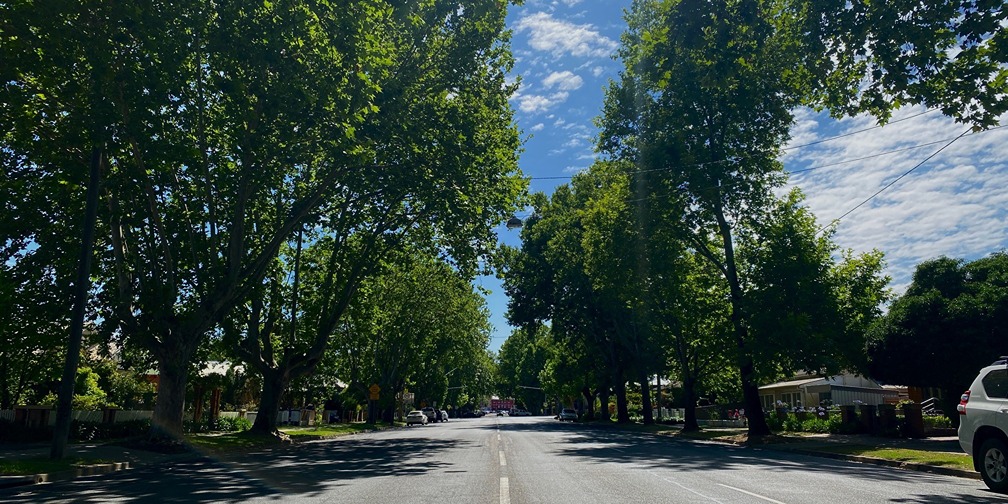
Wagga Wagga City Council captured high-resolution aerial imagery of vegetation and land surface temperatures for a series of projects to cool the city.
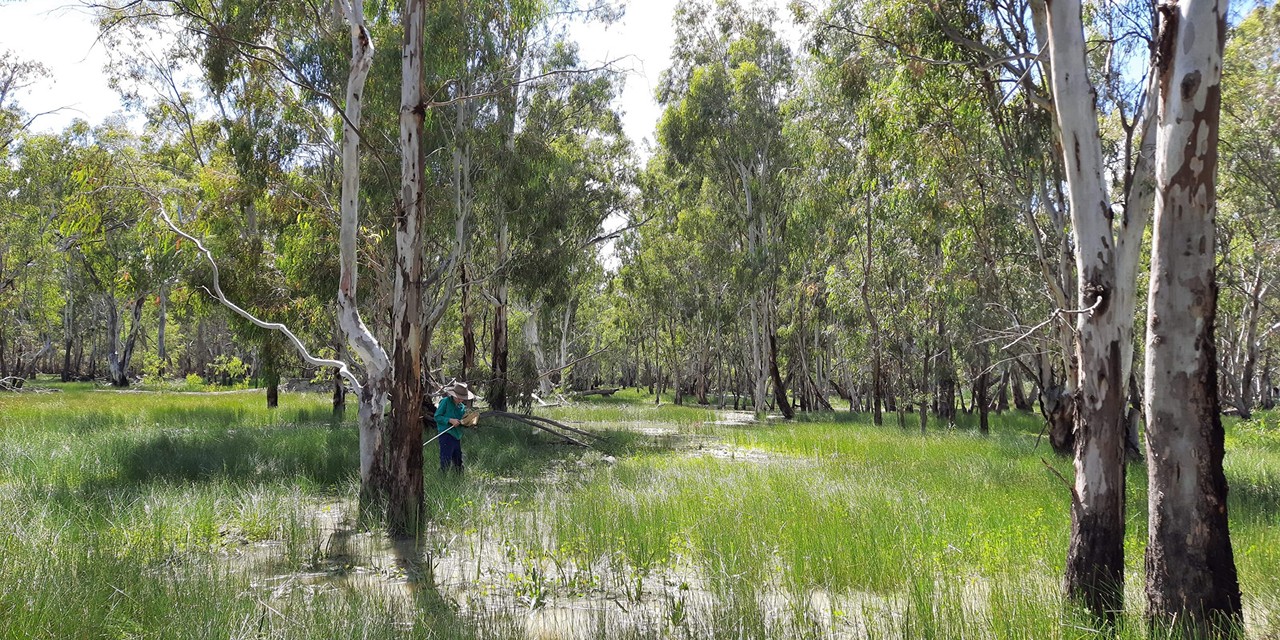
Murray River Council and WMLIG are finding adaptation with projects that grow jobs and agricultural productivity, protect biodiversity and build social capital.
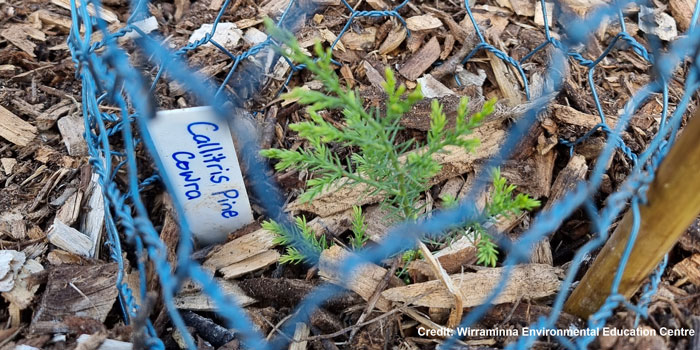
Wirraminna’s dedicated volunteers embarked on a visionary adaption project as climate change alters this biodiversity hotspot.