Key points
- NSW’s Central Coast is known for its beautiful beaches, lakes, coastal lagoons and estuaries. The region supports a range of industries such as tourism, agriculture, health care and social assistance.
- Climate change is affecting the Central Coast, particularly through increasing temperatures. Projections show temperatures are expected to continue increasing, sea levels will rise, rainfall patterns will change and fire weather will increase.
- The NSW Government is helping the Central Coast adapt to climate change through the Enabling Regional Adaptation work. This is being achieved by working with state and local government stakeholders to identify key aspects of the Central Coast region that are vulnerable to climate impacts, along with challenges and opportunities to adapt.
Importance of the Central Coast region








The Central Coast region encompasses the traditional lands of the Darkinyung people. The Central Coast extends from Broken Bay in the south to Frazer Beach in the north. It contains the 2 major town centres of Gosford and Wyong. The Central Coast’s unique environments and proximity to the Hunter and Sydney attract people to the region to live and work.
Its population has a higher proportion of older residents compared to the NSW and ACT average.
The Central Coast includes unique natural environments such as ocean foreshore, coastal lakes, rivers, estuaries, lagoons, valleys and mountains. These features have created corridors that have shaped the region’s development. National parks, State forests, bushland, beaches and waterways occupy over half the region.
The Central Coast supports a diverse range of industries that are vital for NSW’s economy. The largest industries of employment for the region are health care and social assistance, construction, retail trade, education and training, and hospitality services including accommodation and food.
The region’s tourism sector is worth around $880 million annually, which makes up around 9% of the total tourism expenditure in regional NSW. The Central Coast can leverage its natural assets and proximity to Sydney to generate more jobs and economic activity from tourism.
These cultural, environmental and economic values are just some aspects of the region which have been identified as being highly vulnerable to climate change. Climate change is already affecting the Central Coast, particularly through increased temperatures. The impacts of this can be seen through the widespread bushfires of 2019–2020, and increased coastal erosion.
The region’s climate has provided the foundation for many of the region’s current social, ecological and economic systems. Now, climate change is altering these foundations, with impacts already visible and expected to grow as they are impacted by increased temperatures, more hot days, fewer cold nights, higher rainfall variability and greater fire danger.
How the Central Coast is affected by climate change
NARCliM2.0 climate projections at a glance
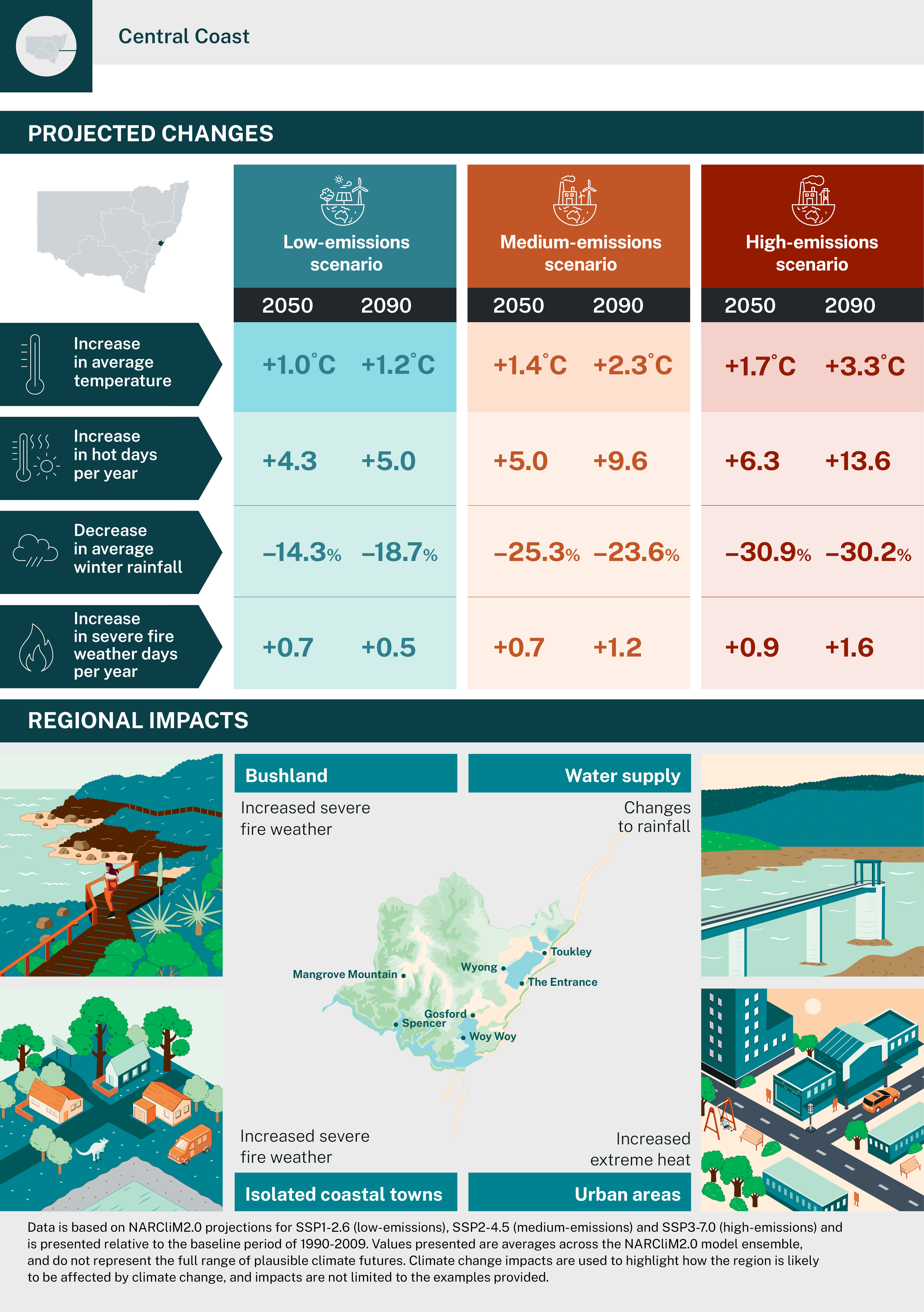
Climate projections for Central Coast are shown relative to a baseline. This consistent reference point (the baseline) avoids the problems that could occur if future projections are measured against a shifting point of comparison, such as a constantly moving 'current' period.
- The baseline period: the modelled average of the 20-year period between 1990-2009.
- Middle of the century (2050): the projected average of the 20-year period between 2040-2059.
- End of the century (2090): the projected average of the 20-year period between 2080-2099.
Detailed information on the projected climate changes for the region can be found in the Central Coast snapshot or explored further through the Interactive climate change projections map.
Projections for the Central Coast





Temperature
Across the Central Coast region, average temperatures are projected to rise throughout this century under all emissions scenarios. The main difference between scenarios is the scale of change: lower emissions show slower and more moderate increases, while higher emissions lead to a greater and ongoing rise in average temperature.
Under a low-emissions scenario, the rate of average temperature increase is expected to slow around the middle of the century. Under medium- and high-emissions scenarios, temperatures are expected to keep climbing past the middle of the century with no sign of levelling off by the end of the century, with faster and greater increases under a high-emissions scenario.
Hot days
Across the Central Coast region, the number of hot days is projected to increase throughout this century under all emissions scenarios. The main difference between scenarios is the scale of change: lower emissions show slower and more moderate increases, while higher emissions lead to a greater and ongoing rise in the number of hot days.
Under a low-emissions scenario, the rate of increase is expected to slow around the middle of the century. Under medium- and high-emissions scenarios, the number of hot days is expected to keep rising past the middle of the century, with no sign of levelling off by the end of the century, with faster and greater increases under a high-emissions scenario.
| Case study Significant population growth is expected in the Central Coast region in the coming decades, from a population of around 347,500 people in 2021 to more than 404,250 people by 2041. The Central Coast region, with its aging population, faces significant impacts from an increase in the number of hot days. Older people have less ability to handle hot days, due to factors often associated with aging, such as poor fitness, body changes and long-term health problems. This makes them more likely to suffer from symptoms of heat strain such as a faster heart rate, higher body temperature and rapid breathing. |
Cold nights
There will be noticeably fewer cold nights in the Central Coast region this century. The main difference between scenarios is the pace and size of the decline: lower emissions slow the change, while higher emissions lead to faster and greater losses.
Under a low-emissions scenario, the decline of cold nights slows around the middle of the century. Under a medium- and high-emissions scenarios, the number of cold nights continues to decline past the middle of the century, with no sign of levelling off, and by the end of the century the region could have very few, if any, cold nights under a high-emissions scenario.
Rainfall
Annual average rainfall in the Central Coast region is projected to remain variable throughout this century but is projected to decline under all emissions scenarios. The main differences between scenarios are in how large the reductions are and when they occur.
By the middle of the century, the high-emissions scenario shows a noticeably greater drop in annual rainfall than the low- and medium-emissions scenarios. By the end of the century, the differences between scenarios change their behaviour, rainfall continues to decline under the low- and medium-emissions scenarios, while the high-emissions scenario shows a slight increase in rainfall from the middle of the century but still remains below current levels.
Severe fire weather
Across the Central Coast region, the number of severe fire weather days is projected to rise throughout this century under all emissions scenarios. The main difference between scenarios is the scale of change: lower emissions show slower and more moderate increases, while higher emissions lead to a greater and ongoing rise in number of severe fire weather days.
Under a low-emissions scenario, the rate of increase is expected to slow around the middle of the century. Under medium- and high-emissions scenarios, severe fire weather days are expected to keep climbing past the middle of the century with no sign of levelling off by the end of the century, with faster and greater increases under a high-emissions scenario.
| Case study The 2019–20 bushfire season caused extensive damage to communities, infrastructure and natural ecosystems in NSW. While large-scale bushfires did not occur in the region itself, there were 16 premature deaths as well as 16 cardiovascular disease and 69 respiratory disease hospitalisations across the region from poor air quality caused by the bushfires. |
Projected sea-level rise and coastal hazards
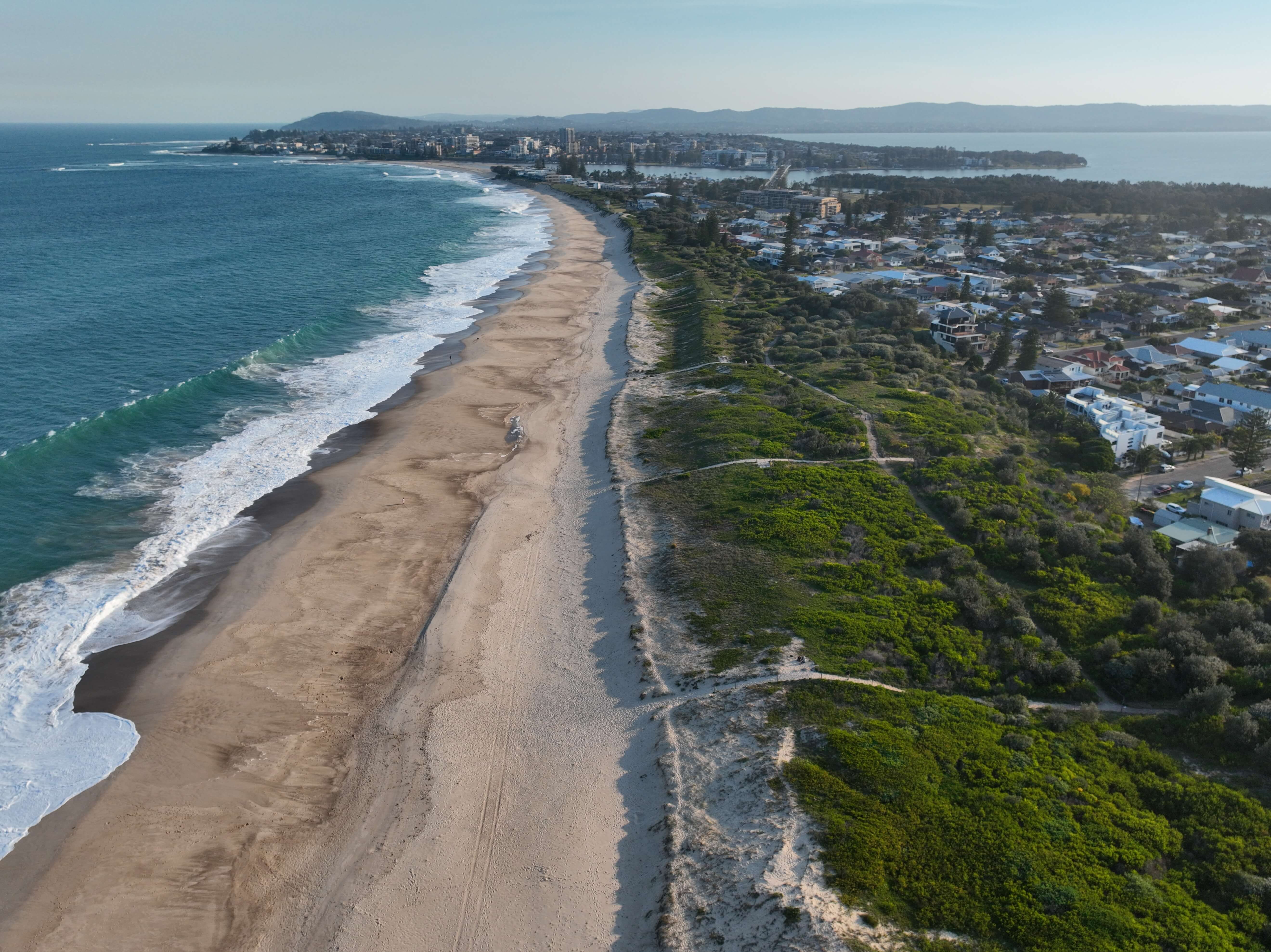
Sea level along the Central Coast is projected to continue rising under all emissions scenarios. At Newcastle - the nearest location with available projection data - sea level is expected to rise by 14–27 cm under a low-emissions scenario (SSP1-2.6) and by 18–31 cm under a high-emissions scenario (SSP3-7.0) by 2050.
Later in the century, the rate of sea-level rise is projected to accelerate under both scenarios, with significantly faster increases under high emissions. By 2100, sea level is projected to rise by 30–62 cm under a low-emissions scenario and 55–96 cm under a high-emissions scenario.
These projections are relative to the 1995–2014 baseline and are based on data from the Intergovernmental Panel on Climate Change (IPCC) Sixth Assessment Report. Further details on the methodology and full set of projections are available through the IPCC Sixth Assessment Report and the NASA Sea Level Projection Tool.
The Central Coast is also expected to face increasing exposure to coastal hazards over time, particularly under higher emissions scenarios. These hazards include coastal erosion, estuarine inundation, and coastal overwash.
Communities, infrastructure, and natural ecosystems in the region are likely to become increasingly vulnerable to the impacts of sea-level rise and associated coastal hazards, especially under a very high- emissions scenario (SSP5-8.5).
Learn more about the impacts of sea-level rise and coastal hazards by accessing the coastal hazards snapshots and technical assessment report.
Adapting to changes in the Central Coast
To help the Central Coast adapt to the impacts of climate change, 150 state and local government stakeholders were brought together in 2019 as part of the NSW Government’s Enabling Regional Adaptation work.
These participants collaboratively identified how different economic, sociocultural and environmental aspects (also known as systems) in the region are vulnerable to climate change. For each of these systems, the vision for a climate-resilient future was identified, and opportunities for action were co-designed. These opportunities can be implemented by state and local government, businesses or community groups.
The Hunter and Central Coast Enabling Regional Adaptation report provides a resource for state and local government and regional communities to understand how climate change will continue to impact the region and our values. It also provides potential opportunities for governments, businesses and communities to adapt to climate change.
The following opportunities for action reflect potential options for state and local government, businesses or community groups to implement. This list has been summarised from the Hunter and Central Coast Enabling Regional Adaptation report. These opportunities provide a starting point for action, and will be reviewed and updated to ensure they continue to reflect climate trends, key vulnerabilities and community values.
Vision
Aboriginal people lead the integration of their cultural knowledge and practice into a sustainable future for everyone. Aboriginal knowledge will be used to heal Country, increase resilience to climate change and take opportunities for land development and emerging markets.
Opportunities for action
- Incorporate Aboriginal cultural knowledge into land and water management.
- Increase the engagement of Aboriginal communities in landuse decision-making.
- Attract and create opportunities for Aboriginal people to be employed in government.
- Encourage and support cultural practice through sharing knowledge, teaching and access to land.
- Listen to Aboriginal voices and facilitate self-determination in Aboriginal communities.
- Support Aboriginal communities to plan for land developments and market opportunities.
- Ensure development projects consider, value and protect Aboriginal heritage and cultural resourcing (e.g. effective resourcing).
- Elect a local Aboriginal leadership group to advise on climate change.
Vision
Systems are re-designed to ensure land and resources are sustainably used and reused, to maximise efficiency and create jobs. Circular economy industries in the Central Coast are established, increasing the efficient use of limited land and natural resources.
Opportunities for action
- Implement state legislation and incentives to support a circular economy, such as pricing on products and the waste levy.
- Facilitate strong collaboration between government and industry to support innovation.
- Encourage and support industries to adopt circular economy principles in land remediation.
- Include circular economy principles in school curriculums and develop training programs to build the skills needed to increase the region’s circular economy capacity.
- Embed circular economy principles and practice through government procurement.
Vision
The community has the capacity to prepare for, respond to and recover from natural disasters. Community resilience is achieved through diverse employment opportunities and people connected to place. The community is cohesive and self-reliant.
Opportunities for action
- Embed equity, empathy and compassion as values in the community.
- Support community leaders to collaborate with emergency management groups.
- Embed Aboriginal values in community resilience building.
- Develop and incorporate new frameworks to guide government and business on matters relating to health and wellbeing.
- Promote sustainable resources through circular economy principles, community-based renewable energy projects and sustainable transport.
Vision
Federal, state and local government work with the community to prevent, prepare for, respond to and recover from disaster events. Communities are better prepared and more resilient with robust communication and strategic emergency management planning.
Opportunities for action
- Establish a coordinated government structure that includes changes to legislation and state plans, and effective communication between government and communities.
- Drive change in the culture of emergency management services to break down barriers between government and community responders.
- Develop effective ways to share services across all emergency management precincts.
- Develop protocols for agreed and approved datasharing and availability.
- Create sustainable volunteering models through training and support.
Vision
The region has sustainable and diversified food and energy sectors. The impacts of climate change on food and energy production are decreased.
Opportunities for action
- Adopt tourism strategies that focus on the Central Coast’s unique local produce and ecotourism.
- Implement innovative pathways to expand the region’s renewable energy capacity.
- Invest in, research and develop farming practices that are sustainable for the future.
- Develop education materials to encourage youth participation in new industries and community partnerships.
- Invest in natural capital, circular economy, innovation and technology adoption, and renewable energy.
Vision
Planning supports community resilience by proactively embedding climate change in all decision-making. The effects of climate change, extreme weather events, population growth and changing demographics are planned for.
Opportunities for action
- Integrate regional adaptation priorities into the planning process.
- Fund local councils to deliver climate change adaptation resilience projects in the community.
- Assess the climate vulnerability and risk regularly to inform local planning and strategy.
- Implement state legislation and regulation so that councils must consider climate change during planning.
- Develop objectivebased decision frameworks with adaptation options such as infrastructure improvement, appropriate construction materials, funding, property buybacks and rehousing.
- Raise awareness on climate adaptation and resilience in the community.
- Improve access to geospatial and landuse data and support open data sharing at a state-level to support local council decisionmaking.
- Implement state legislation and regulation so that councils must consider climate change during planning.
Vision
Natural ecosystems are protected and more resilient to the impacts of climate change. Appropriate community access to natural areas is encouraged, and the importance of the environment is recognised.
Opportunities for action
- Create and implement effective ecosystem management and conservation plans which consider climate change.
- Develop and deliver community programs that focus on environmental stewardship and the importance of indigenous and other social and cultural ecosystem values.
- Develop innovative approaches to funding and incentives to protect natural environments.
- Develop and implement programs to support the migration and conservation of species that have limited ability to adapt; for example, designing and constructing wildlife refuges and corridors.
Vision
The Central Coast’s infrastructure effectively and efficiently moves goods, people, energy and information by rail, road, air and water, and through wired and wireless networks. The industry has reduced its carbon footprint through diversification and a transition to lowcarbon products.
Opportunities for action
- Provide integrated transport and infrastructure services that incorporate climate risk and smart landuse planning.
- Improve the understanding of transport system interdependencies and alternatives to help build resilience.
- Create and support localised economies, multipurpose facilities and infrastructure.
- Identify ways to reuse redundant infrastructure.
- Support innovative risk-based approaches and proactive planning to prioritise and design sustainable transport infrastructure.
Vision
Water quality and availability is secure across the region. Environmental flows are protected, water harvesting is appropriately managed, and recycled water is used. The impact of climate change on water demand within the Central Coast is managed.
Opportunities for action
- Review and reform the assessment process for water and infrastructure projects to align with climate risks.
- Develop and deliver community education programs to increase their involvement in wateruse planning and decisionmaking.
- Develop a holistic approach to collaboration across governments to support better wateruse planning and asset management.
- Support and develop locallyspecific innovations that account for climate risks.
- Develop solutions that are catchment based and specific for the region.
How we've been adapting so far
With the knowledge and partnerships gained through the Hunter and Central Coast Enabling Regional Adaptation work, there is an opportunity for council, government and communities to show leadership and consider this work in their plans to respond to climate change.
Some opportunities for action are already being addressed by government, community, households and business, to help the Central Coast adapt to the impacts of climate change and build a sustainable, productive and equitable future.
One example of action being taken is Lake Macquarie City Council’s Community monitoring and foreshore inundation project. This project explored risks to foreshore infrastructure, such as roads, communication lines, and drainage systems from inundation by engaging the community in the monitoring and assessment of tidal flap effectiveness.
Other examples include the projects supported by the Building Resilience to Climate Change grants and Increasing Resilience to Climate Change grants.
If you have an example of how a community group, business or local government is adapting to climate change, email AdaptNSW so we can share your story.
Together, we can adapt to climate change impacts and continue to work towards a positive future for NSW.
How to adapt to climate changeCase studies from the Central Coast

Creative practice is a powerful tool for climate adaptation. In the Hunter Region, the Recipe for Resilience workshop used a simple cake metaphor to turn shared ideas into new connections, collaboration and action.
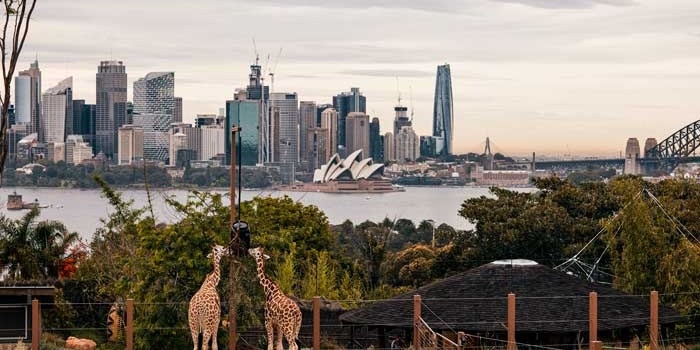
Ensuring there’s enough water in the moat may not be a common challenge for those preparing for changing climate conditions.
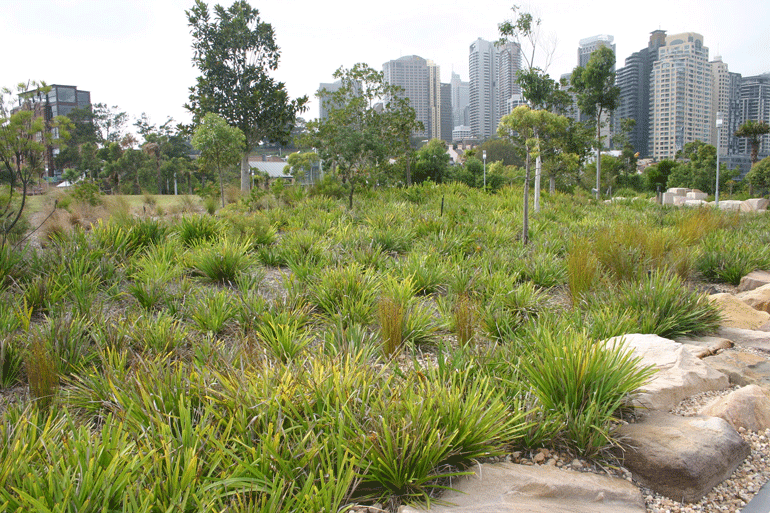
The role of the Greater Cities Commission (GCC) is to coordinate and align the planning that will shape the future of the Six Cities Region. The GCC are using a tool that applies NARCliM regional climate projections to assess the socioeconomic risks of climate change for the region.