Key points
- The Far West region is the largest in area in NSW, covering 40% of the state, and contains fragile environments which are home to a diverse range of native species.
- The region supports industries including agriculture, tourism and mining, and has a rich cultural heritage, with 30,000-year-old Aboriginal rock carvings and many pastoral and mining heritage places.
- Climate change is affecting the Far West region, particularly through increasing temperatures. Projections show temperatures are expected to keep rising, rainfall patterns will change and droughts will be more severe.
- The NSW Government is helping Far West region adapt to climate change through the Enabling Regional Adaptation work. This is being achieved by working with state and local government stakeholders to identify key aspects of the Far West region that are vulnerable to climate impacts, along with challenges and opportunities to adapt.
Importance of the Far West region








The Far West region encompasses the traditional lands of the Barundji, Karenggapa, Wadilgali, Malyangaba, Bandjigalia, Wandjiwalgu, Wiljali,Danggali, Barkindji, Barindji and Wongaibon peoples. The region includes the city of Broken Hill and remote towns such as Bourke, Cobar and Walgett. The Barwon–Darling River system connects Far West communities to each other, and to the southern shires of Wentworth and Balranald.
Its population has a higher proportion of older residents compared to the NSW and ACT average.
The Far West is the largest region in NSW and one of the most environmentally diverse, covering 40% of the state. The landscape of the region is mostly flat, which supports wide floodplains and tributaries into the Darling River. The region has a high diversity of species and ecosystems, including the internationally recognised Willandra Lakes Region World Heritage Area, 6 national parks and 12,462 Aboriginal cultural heritage sites.
In the Far West region, iron ore mining is currently the largest economic contributor. Tourism, renewable energy, arts and culture are emerging industries in the region.
The Far West supports a diverse range of industries that are vital for NSW’s economy, The largest industries of employment for the region are health care and social assistance, agribusiness, education and training, mining and retail trade.
These cultural, environmental and economic values are just some aspects of the region which have been identified as being highly vulnerable to climate change. Climate change is already affecting the Far West region, particularly through increased temperatures. The impacts of this can be seen through recent prolonged drought conditions.
The region’s climate has provided the foundation for many of the current social, ecological and economic systems. Now, climate change is altering these foundations, with impacts already visible and expected to grow as they are impacted by increased temperatures, more hot days, fewer cold nights, higher rainfall variability and greater fire danger.
How the Far West is affected by climate change
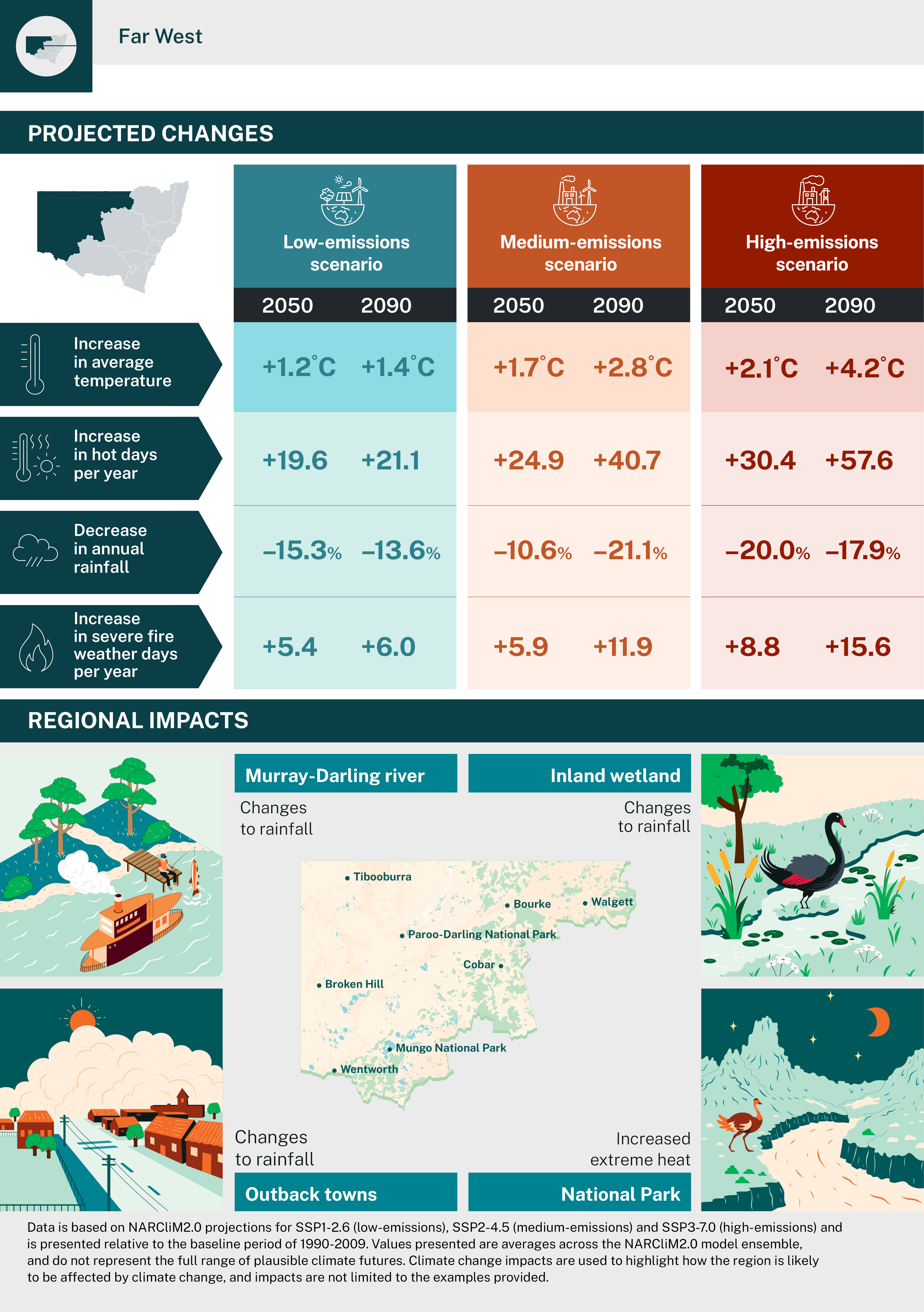
Climate projections for the Far West are shown relative to a baseline. This consistent reference point (the baseline) avoids the problems that could occur if future projections are measured against a shifting point of comparison, such as a constantly moving 'current' period.
- The baseline period: the modelled average of the 20-year period between 1990-2009.
- Middle of the century (2050): the projected average of the 20-year period between 2040-2059.
- End of the century (2090): the projected average of the 20-year period between 2080-2099.
Detailed information on the projected climate changes for the region can be found in the Far West snapshot or explored further through the Interactive climate change projections map.
Projections for the Far West









Temperature
Across the Far West region, average temperatures are projected to rise throughout this century under all emissions scenarios. The main difference between scenarios is the scale of change: lower emissions show slower and more moderate increases, while higher emissions lead to a greater and ongoing rise in average temperature.
Under a low-emissions scenario, the rate of average temperature increase is expected to slow around the middle of the century. Under medium- and high-emissions scenarios, temperatures are expected to keep climbing past the middle of the century with no sign of levelling off by the end of the century, with faster and greater increases under a high-emissions scenario.
Hot days
Across the Far West, the number of hot days is projected to increase throughout this century under all emissions scenarios. The main difference between scenarios is the scale of change: lower emissions show slower and more moderate increases, while higher emissions lead to a greater and ongoing rise in the number of hot days.
Under a low-emissions scenario, the rate of increase is expected to slow around the middle of the century. Under medium- and high-emissions scenarios, the number of hot days is expected to keep rising past the middle of the century, with no sign of levelling off by the end of the century, with faster and greater increases under a high-emissions scenario.
| Case study Heatwaves have been responsible for more human deaths than any other natural hazard, including bushfires and floods. Heatwaves occur when both maximum and minimum temperatures are unusually hot over 3 days, compared to the previous month and historical weather. Heatwaves in 2011 and 2019 led to a 14% rise in NSW hospital admissions. In 2009, the heatwave in Victoria preceding the 2009 bushfires led to 374 deaths, with the bushfires directly responsible for 173 deaths. |
Cold nights
There will be noticeably fewer cold nights in Far West this century. The main difference between scenarios is the pace and size of the decline: lower emissions slow the change, while higher emissions lead to faster and greater losses.
Under a low-emissions scenario, the decline of cold nights slows around the middle of the century. Under a medium- and high-emissions scenarios, the number of cold nights continues to decline past the middle of the century, with no sign of levelling off, and by the end of the century the region could have very few, if any, cold nights under a high-emissions scenario.
Rainfall
Annual average rainfall in the Far West is projected to remain variable throughout this century but is projected to decline under all emissions scenarios. The main differences between scenarios are in how large the reductions are and when they occur.
By the middle of the century, the high-emissions scenario shows a noticeably greater drop in annual rainfall than the low- and medium-emissions scenarios. By the end of the century, the differences between scenarios change their behaviour, rainfall continues to decline under the low- and medium-emissions scenarios, while the high-emissions scenario shows a slight increase in rainfall from the middle of the century but still remains below current levels.
| Case study Increased rainfall variability from climate change is predicted to have significant impacts on the internationally significant Ramsar wetlands of the Far West such as the Paroo River Wetlands and Narran Lakes (Dharriwaa). For the Paroo River Wetlands, annual streamflow has already declined by 28% and waterbird abundance declined by 50% from 1981 to 2020 due to changes in temperature and rainfall. More severe droughts could be possible under a future climate, resulting in significantly lower inflows into the Barwon–Darling River than those experienced in 2017–2020, which would impact town water supplies and agricultural production. |
Severe fire weather
Across Far West region, the number of severe fire weather days is projected to rise throughout this century under all emissions scenarios. The main difference between scenarios is the scale of change: lower emissions show slower and more moderate increases, while higher emissions lead to a greater and ongoing rise in number of severe fire weather days.
Under a low-emissions scenario, the rate of increase is expected to slow around the middle of the century. Under medium- and high-emissions scenarios, severe fire weather days are expected to keep climbing past the middle of the century with no sign of levelling off by the end of the century, with faster and greater increases under a high-emissions scenario.
Adapting to changes in the Far West region
To help the Far West region adapt to the impacts of climate change, state and local government stakeholders were brought together in 2016 as part of the NSW Government’s Enabling Regional Adaptation work.
These participants collaboratively identified how different economic, sociocultural and environmental aspects (also known as systems) in the region are vulnerable to climate change. For each of these systems, the vision for a climate-resilient future was identified, and opportunities for action were co-designed. These opportunities can be implemented by state and local government, businesses or community groups.
The Western Enabling Regional Adaptation – Far West region report provides a resource for state and local government and regional communities to understand how climate change will continue to impact the region and our values. It also provides potential opportunities for governments, businesses and communities to adapt to climate change.
The following opportunities for action reflect potential options for state and local government, businesses or community groups to implement. This list has been summarised from the Western Enabling Regional Adaptation – Far West region report. These opportunities provide a starting point for action, and will be reviewed and updated to ensure they continue to reflect climate trends, key vulnerabilities and community values.
Vision
Small, remote communities that are separated by large distances have stabilised populations and are supported by the development of Broken Hill. Far West towns are resilient with climate-smart housing and infrastructure, with access to essential services. Long-term strategic planning attracts people to the region and the economy is diversified to reduce reliance on agriculture and mining.
Opportunities for action
- Support stronger regional settlements with coordinated physical and social infrastructure adapted to climate and community needs.
- Develop and support strong Far West voices to advocate for regional priorities, opportunities and investments.
Vision
The Far West economy that supports vibrant and sustainable industries offering diverse employment opportunities through a commitment to regional development and innovation. Investments are made in supporting infrastructure, such as telecommunications and public transport, innovative remote regional health and education services. By 2050, the Far West economy is supported by a diversified and sustainable skilled workforce.
Opportunities for action
- Develop and invest in innovative services and technologies that support an inclusive, diversified and vibrant economy.
- Invest in remote health technology, such as telehealth and video services.
- Increase access for local contractors to deliver goods and services.
Vision
The tourism sector supports and grows the visitor economy to Broken Hill and throughout the Far West region. Tourism contributes to a thriving regional economy, drawing on its unique experiences in eco-tourism and cultural heritage, boosting visitation for events and conferences. The sector is supported by fast IT and communications infrastructure, secure water supplies, and improved transport links for increased access.
Opportunities for action
- Encourage collaborations to grow and promote a range of tourism opportunities and hospitality services. Tourism opportunities include cultural heritage tourism, ecotourism and the Broken Hill Festival.
- Improve transport links to the region through sealed roads, increased flights and rail services.
- Encourage collaboration within the tourism industry and between stakeholder groups.
Vision
The prosperity of remote settlements is underpinned by a secure, continued supply of water for multiple uses. Regional water sources are governed under water-sharing plans secured for the community, industry and the environment using effective urban design and efficient infrastructure. Environmental flows are secured to support ecosystems, and water harvesting and storage are improved through appropriate infrastructure.
Opportunities for action
- Reform the planning and assessment process for water and infrastructure projects.
- Educate and engage the community so they can participate in water-use planning and decision-making.
- Provide funding and incentives to protect and improve vegetation along rivers, and wetlands.
- Design and build water-efficient developments.
Vision
Rangeland grazing and conservation on private lands recognises that healthy ecosystems support biodiversity and enhance food security. The grazing system consists of diverse, future-oriented family farms in biodiverse landscapes and is supported by payments for ecosystem services. The government partners with landowners to share the cost of conservation, and high conservation value sites are protected.
Opportunities for action
- Encourage and promote alternative land uses to diversify farm businesses.
- Encourage private land conservation.
- Provide stable policy and incentives for improvements.
- Maintain and facilitate family farms as a viable business option.
- Develop ecotourism to fund conservation.
Vision
The Far West energy system is decentralised, with renewable energy generation that is secure, reliable and cost-effective. Community owned clean energy powers energy efficient buildings with increased human comfort, and local transport and infrastructure use renewable energy to reduce emissions. The Far West is a recognised market leader in clean energy technology and provides energy to neighbouring regions.
Opportunities for action
- Establish incentives and strategies to encourage innovative systems and investment, to support clean energy generation and storage.
- Support the regional workforce to transition to clean energy jobs, though training and reskilling.
- Encourage culture change to transform energy use in the region.
Vision
The Far West reserve system maintains diverse natural and cultural values which are integrated across private land and the NSW reserve system. Healthier landscapes support and conserve regional biodiversity. Investments have improved the monitoring and knowledge of species populations, leading to appropriate adaptive management. The reserve systems use traditional owners in park management, and increased employment is created through Aboriginal businesses that align with reserve values, such as bush foods.
Opportunities for action
- Promote the use of new technologies and partnerships to better integrate land conservation for community decision-making and planning.
- Integrate private land conservation with the public reserve system.
- Increase ecotourism to the region.
How we’ve adapted so far
With the knowledge and partnerships gained through the Far West Enabling Regional Adaptation work, there is an opportunity for council, government and communities to show leadership and consider this work in their plans to respond to climate change.
Some opportunities for action are already being addressed by government, community, households and business, to help the Far West adapt to the impacts of climate change and build a sustainable, productive and equitable future.
One example of action being taken is a water-resilient community garden by Dharriwaa Elders Group Incorporated. This project renewed a community garden, making it more resilient to drought, and reducing greenhouse gas emissions from food transport by providing local food for the community.
Other examples include the projects supported by the Building Resilience to Climate Change grants and Increasing Resilience to Climate Change grants.
The Enabling Regional Adaptation work has already been used to inform government planning in the Far West region, through the Far West Regional Plan 2036. Incorporating this work into regional and state plans ensures climate change risks specific to the Far West are included.
If you have an example of how a community group, business or local government is adapting to climate change, email AdaptNSW so we can share your story.
Together, we can adapt to climate change impacts and continue to work towards a positive future for NSW.
How to adapt to climate changeCase studies from the Far West
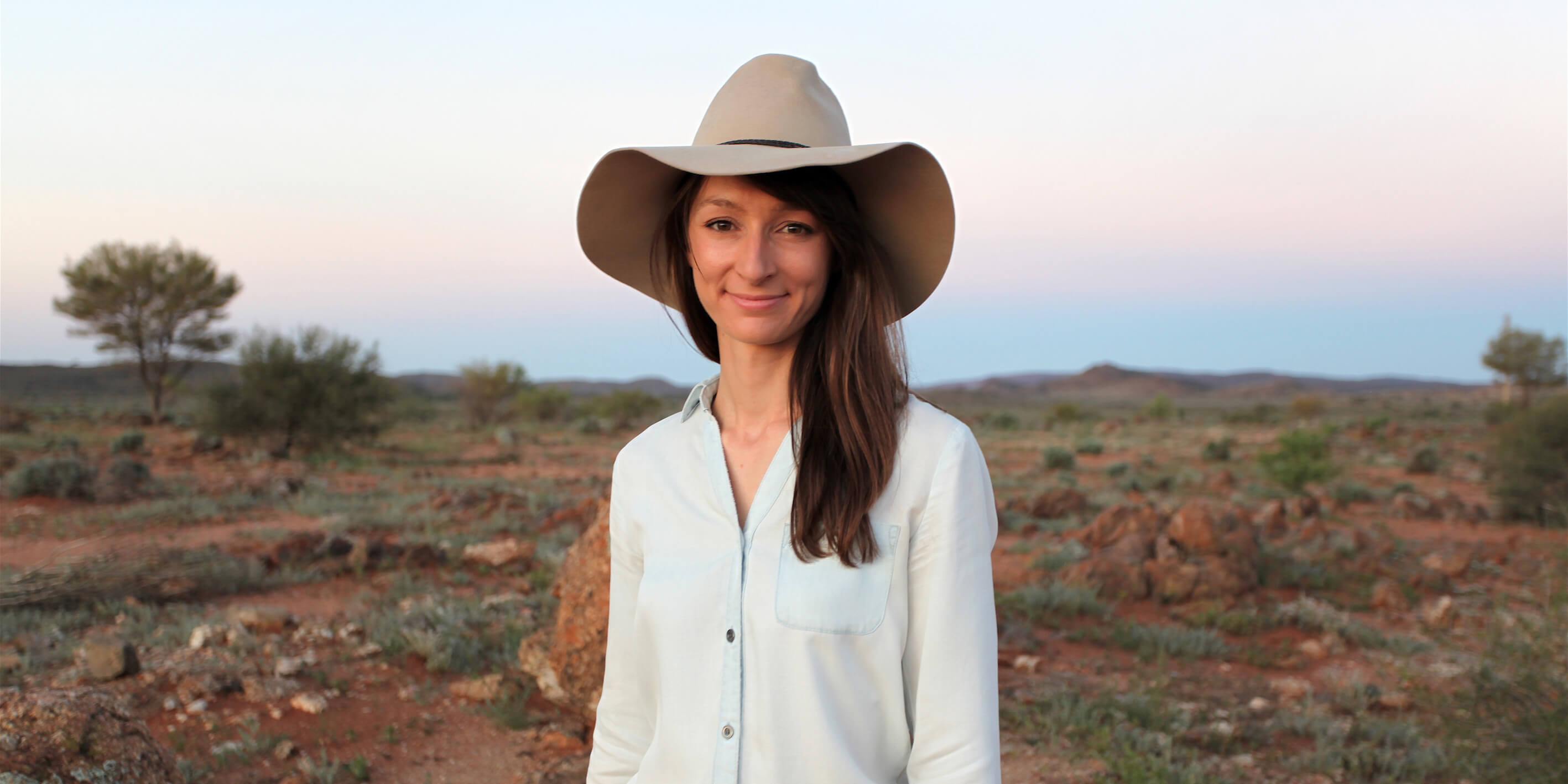
Find out how life in on a farm in Broken Hill led to an understanding of how climate change is related to the food we eat.